


BEES! A Local Story with National Reach
Directed the production and tour of a 2,500 sq ft national exhibition blending immersive environmental design with interactive interpretation on bees as an indicator species across ecology and culture.


Being Punjabi - A Community Co‑Curated Exhibition. Orchestrated an award-winning, community co-curated exhibition amplifying dozens of Punjabi-Canadian voices and stories, coordinating advisors, community artifact loans, and hands-on multimedia content production.


PASSAGE Art Space
Conceived and developed PASSAGE, to solve project needs and align audiences,. Transformed a 50-foot corridor in a mixed-use redevelopment by New Urban Development company into a public art space that aligned building users.


Ancient Peru Unearthed - North American Premiere
Led the premiere and multi‑city tour of a $26M international gold exhibition, overseeing content development, vendor management, bilingual publication, media production, artifact selection, secure logistics, and all agreements.


Surrey Stories - Digital Museum of Canada Project. Secured $150K Digital Museums Canada funding and led phases 1–2 of a three-year digital museum initiative: RFP process, UX-driven planning, budget development, and content strategy including interactive mapping and short-form video storytelling for youth audiences.


IAIN BAXTER& -Art in a Flash
I created an eco‑friendly, limited‑edition exhibition catalogue for conceptual artist IAIN BAXTER&, transforming archival materials, interviews, and installation footage into a flash‑drive “object in a jar” that echoed his iconic environmental works and solved budget constraints.
The jar packaging was chosen to model one of BAXTER&'s most seminal artworks "Animal Preserve"


Founders Gallery - Creating a New Art Gallery from the Ground Up. Directed the creation of a 5,000 sq ft gallery at The Military Museums, leading strategic planning, vendor coordination, and national loans while launching the space with an inaugural Group of Seven exhibition.


Surrey on Screen - Film Legacy
Led strategy and development for Surrey on Screen, shaping narrative, design, and partnerships with Warner Bros., Paramount and the local film network, while securing full cost coverage and over 80 assets from the Warner Bros. Archive in LA, including a custom sizzle reel highlighting Surrey‑filmed productions.


Our Colours Our Stories: Identity Tapestry.
I partnered with the lead brand strategist at HCMA Architecture + Design to co-curate an exhibit exploring the origins of the museum’s new brand colours, drawing on textile traditions from diverse communities represented in the collection.
I created Identity Tapestry, a participatory installation designed to help visitors see themselves reflected in the museum’s story. One visitor shared emotionally that it was the first time she had ever felt represented in a museum space.

Surrey on Screen exhibition
Creative Production Lead | Museum of Surrey | 2022
I led the ideation, strategy, and development of a major exhibition highlighting Surrey’s growing film industry, reframing local creative identity through storytelling and community engagement. After pitching the concept, I built partnerships with the City of Surrey Film Office, Heritage Collection, and local BIA, and negotiated collaboration with Warner Bros. Discovery and Paramount.
Through an exclusive partnership with the Warner Bros. Archive, I secured the loan of more than 50 production artifacts and negotiated studio support covering international shipping and the participation of two Warner archive technicians — a significant cost offset for the project. Highlights included a custom sizzle reel of locally filmed productions and a feature artifact from Paramount — Jim Carrey’s Sonic the Hedgehog costume — secured through careful negotiations alongside the Warner partnership. Working with my team, we also developed hands-on experiences such as a green screen activity and produced original video interviews with diverse industry professionals.
The project strengthened industry relationships, elevated awareness of Surrey as a film hub, and created an engaging, accessible learning experience for visitors.
Superman costume from Superman & Lois, Warner Bros. Archive.
Photo Courtesy of Steve Bednash.
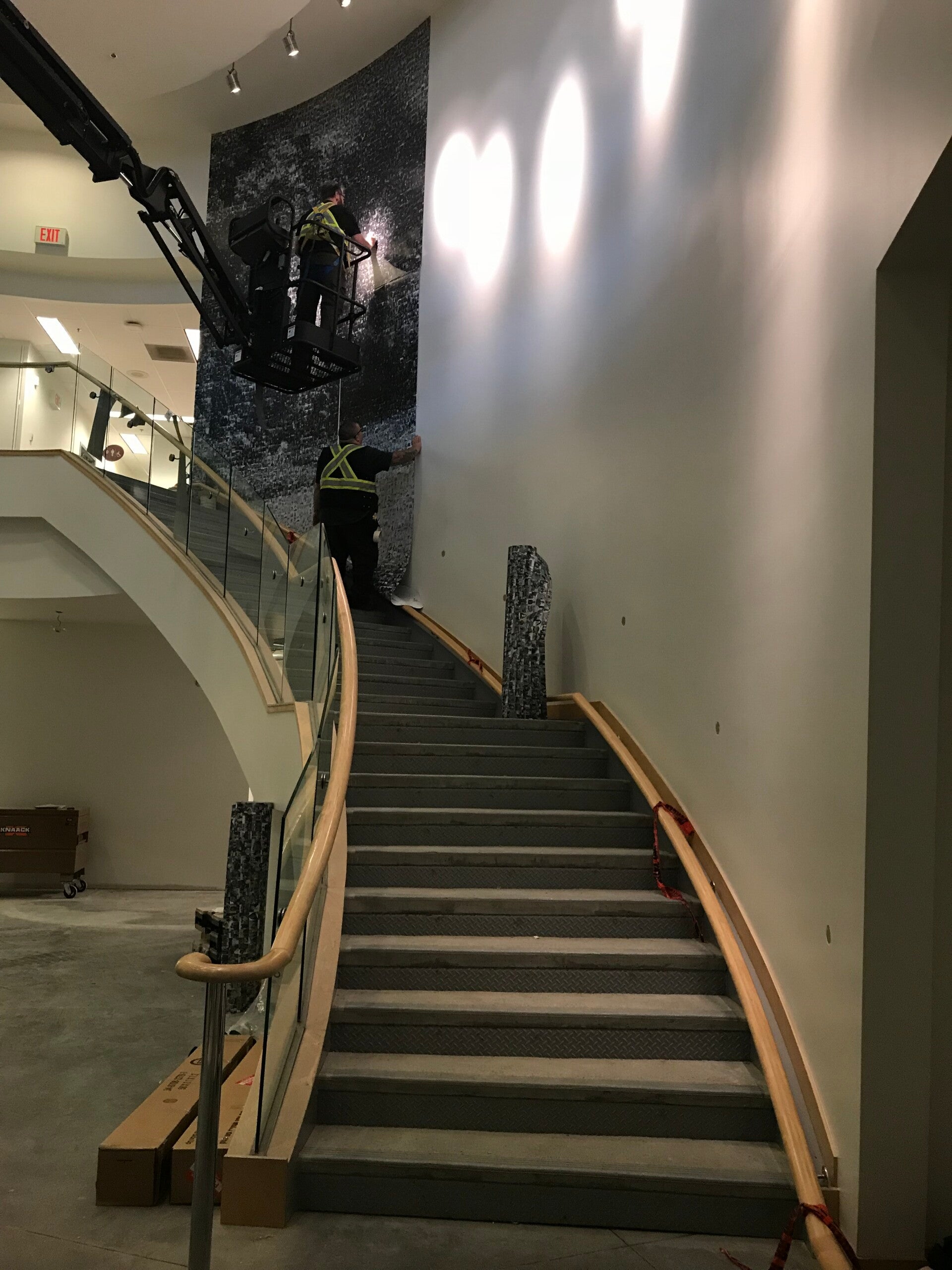
A People's Museum: Mural Wall Project
Experience Design & Project Lead | Museum of Surrey 2018
Upon joining the Museum of Surrey, I noticed the vast 45-by-30-foot atrium wall presented an untapped opportunity. I felt it could be used to align with one of the museum's goals - to create "wow" experiences. The overall image is of a local river, inspired by an Indigenous Elder's words about rivers as places of connection. He also said rivers were the place of arrival for newcomers, and the custom was to ask permission of the resident Nation when arriving at a new place. The image symbolically requests permission to the three land-based Nations of Surrey, and connects the museum's 2 levels. It leads visitors to second floor galleries, including the Nations led Indigenous Hall.
I proposed, sourced suppliers and content, and oversaw the development of this large-scale photo mural. It is designed to reflect the community it serves - the people of the museum. The mural is made up of 44,000 individual portraits of the people of Surrey.
This project supported the museum’s new mission to be "The Best People Museum In Canada" and required aligning stakeholders, sourcing and negotiating with an international designer in the Netherlands, coordinating a community-wide photo collection, and partnering with a local printer (Uno Digital) to deliver an unprecedented technically complex installation. The final mural, is composed of more than 44,000 contemporary and archival images. It blends storytelling, representation, and interactive discovery. Local people are literally seen IN the museum.
The mural has become a signature feature of the museum. It drew more than 10,000 visitors at reopening and continues to foster a strong sense of belonging and engagement within the community.

Being Punjabi: Unfolding the Surrey Story
Being Punjabi: Production Lead & Experience Design| Museum of Surrey | 2019
I spearheaded the end-to-end production of this landmark exhibition, which reframed the narrative for Western Canada’s largest Punjabi community. The project was built on a foundation of "Radical Inclusion" a move beyond the traditional institutional perspective. I wanted to create an experience authentically authored by the community in their own voice. To achieve this, I pioneered a technique for exhibit text panels modeled after magazine editorials; fourteen community leaders authored the texts and each received individual recognition through personal biographies. Every panel appeared in English and Gurmukhi script, with selections in Shahmukhi to be representative.
This vision required the management of complex technical and linguistic workflows. I oversaw the hiring of translators, coordinated community verification checks, and arranged for the transcription of texts into Unicode to support the custom typography required by our design partner, Skyrocket Digital. To build the trust required for artifact loans, I personally led engagement sessions at six sites across Surrey. I also served as a key project Content Producer, overseeing the shoot and personally editing 10 films that featured authentic perspectives from the community.
The exhibition won two BC Museums Association awards: the People's Choice for Best Exhibit and the Award for Excellence in Community Engagement. I subsequently took the initiative to scale this success, successfully securing a $150,000 Digital Museums of Canada grant to transition the physical exhibit into a permanent digital storytelling legacy.

Ancient Peru Unearthed
Curator & Exhibit Coordinator
North American Premiere | The Nickle Arts Museum
I served as Curator and Exhibition Coordinator for the North American premiere of Ancient Peru Unearthed, an international exhibition featuring more than $26 million in priceless artifacts. What began as a curatorial role expanded into coordination across multiple areas of development and production for this complex exhibition and touring project.
Working closely with a multidisciplinary museum team, I shaped and wrote exhibition content and interpretive materials for this bilingual exhibition, and oversaw multimedia production, commissioning an audio tour from a specialist vendor and co-produced an original exhibition video. I coordinated external collaborators including designers, model builders, and technical vendors, and contributed to educational programming, special events, and custom merchandise developed to extend the learning experience beyond the gallery.
The project required significant international coordination and negotiation. In collaboration with partners in Peru, I helped develop and negotiate the exhibition agreement with the Republic of Peru, coordinated contributor agreements, and supported the planning and coordination of the national tour, including venue partnerships and logistics.. The exhibition included a high-profile diplomatic opening attended by Canadian and Peruvian officials, fundraising initiatives, and a bilingual publication for which I authored an essay examining the ethical and cultural consequences of artifact looting.
This work strengthened my ability to design multimodal learning experiences and contribute to complex cross-cultural projects involving international loans, large collections, and national distribution.
Ceramic blackware double spouted vessel depicting the Sican deity. Photo Y Yoshii/PAS, edit by CLEANPIX, from Ancient Peru Unearthed Sican - ISBN-13:978-0-88953-306-6
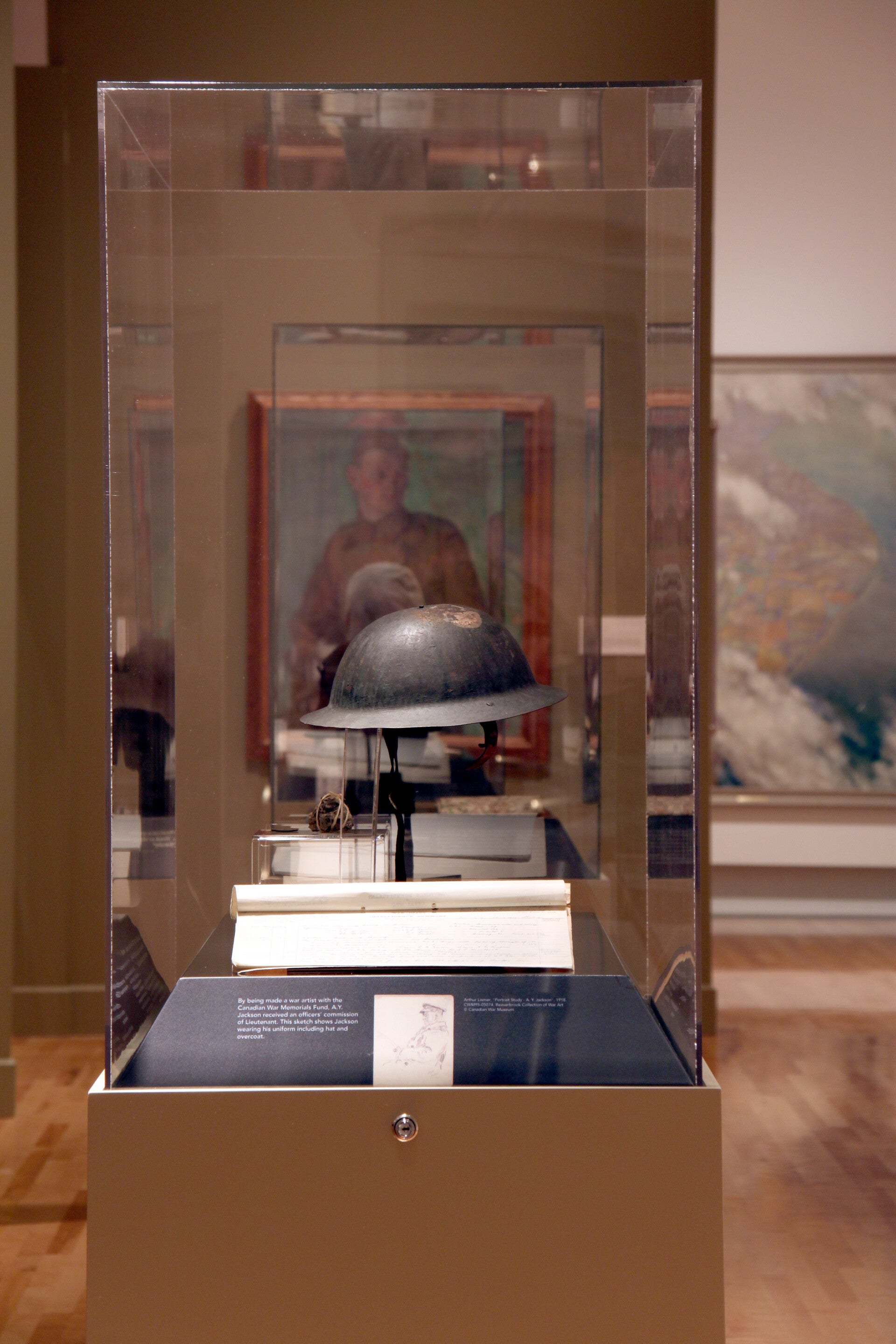
Forming and Launching The Founders' Gallery
Inaugural Gallery & Experience Lead |The Military Museums | 2009
A case study in building a cultural program from the ground up. This project tracks the transformation of a vision into a 5000 sq. ft. operational reality, The Founders Gallery of Art and Heritage at The Military Museums in Calgary, Alberta. This art gallery on it's inception, pioneered a storytelling model uniting fine art, artifacts, and archival material to connect military and art audiences.
Seconded from the University of Calgary, I was tasked to oversee the development of the institution’s art program from concept to full operation, including advising on the build and facility requirements.
Working largely independently in the early phase, I defined the gallery’s mission, brand identity, policies, and programming framework while hiring and coordinating technical staff and establishing operational standards. This included developing collections and loan procedures, designing storage and loading dock, and advocating for the facility to comply with Category “A” museum standards required for major national loans.
The inaugural exhibition, Art in the Service of War: The Emergent Group of Seven, demonstrated a storytelling approach that united fine art, artifacts, and archival material. Significant works by iconic Group of Seven artists were presented alongside objects and archival material drawn from each of the regimental army collections, Archive, Navy, and Air Force museums within The Military Museums. This was done intentionally to bridge art and military history audiences and to amplify the lived experience of the war artists and the works they created.
The premiere exhibition responded to a lead donor’s vision that the gallery open with Group of Seven art, which I leveraged into an opportunity to create a broader narrative exploring the lens of these artists as official war artists, where their later style developed.
The exhibition was sourced through a major loan partnership I negotiated with the Canadian War Museum, including the loan of rare works on paper by the artists later to become The Group of Seven, which had not been on display since 1924 as part of Lord Beaverbrook’s First World War art program documenting the Canadian Expeditionary Force.
This exhibit later informed my published conference paper, "The New Triple A – Art, Archive and Artefact at The
Military Museums: Lessons and Implications from a Converged Environment" by Colleen Sharpe and John Wright at the Fourth Annual Conference of the Arts, Venice, July 28-31 2009.
My final act as Curator was in making a request, proposal and negotiation with the Port Authority of New York and New Jersey to secure a World Trade Center artifact for The Military Museums, commemorating Canadians lost on September 11. This significant addition to the museum was made possible through the vision, advisement, and recommendation of Canadian war artist Dick Averns, who carried the project through to final installation.